
Compare Allen County Property Value Types
Allen County assessments serve Indiana tax administration. The Assessor applies cost, income, and sales-comparison approaches, and each card separates land, improvements, and certified totals by year. A transfer field is a past sale clue only, never a substitute for the annual assessment.
| Value | What It Is | Where |
|---|---|---|
| Assessed value | Tax-oriented value under Indiana rules | Assessor card and PATI |
| Market value-in-use | Mass-appraisal estimate of a property's utility in its current use | Assessment record |
| Last sale price | Consideration tied to a prior transfer when reported | Card, sales disclosure, deed |
| Land and improvements | Components that form the certified total | Assessor card |
Indiana sets a clear ratio goal. It targets 100 percent of market value-in-use, yet that does not mean an assessed value predicts what a buyer and seller will negotiate. Mass appraisal builds the number for one assessment date and cycle.
Read the Allen County Value Fields Together
The official sample card packs in plenty of detail. Certified land, improvement, and total assessed values appear by year, alongside work in progress, residential components, finished square feet, baths, effective year built, construction code, neighborhood factor, location cost multiplier, and prior transfer information. Those fields explain why nearby Allen County homes can carry different totals. Match the year labels first. A prior certified value beside a new trending value shows change over time, not two rivals for one date. Property cards with transfer or value changes refresh monthly.
Allen County's 2026 Value Trend in Context
Allen County's 2026 tax FAQ offers useful context. It says 2024 closed sales informed the 2025-pay-2026 assessments. Median sale price rose 5.6 percent and overall net assessed value rose 4.34 percent, after a 10.1 percent jump the prior tax year. Those are countywide indicators, not a parcel appraisal. A statewide cyclical reassessment starts July 1, 2026, covering roughly 25 percent of property each year across four years for 2026-pay-2027 taxes. Annual trending can still move a parcel between those physical reviews.
Look Up an Allen County Property Value
The Assessor card search is flexible. Enter a last name, a shortened address, or a full parcel number; the county recommends the less-specific route of a number plus the core street name. PATI accepts a name, address, parcel, or duplicate number.
- Search the address and confirm the situs and full parcel number.
- Read land, improvement, and total certified values for the same assessment year.
- Review prior transfer date and sale price, then confirm the instrument at the Recorder.
- Use COMPS to inspect relevant comparable sales without assuming every nearby parcel is comparable.
- Assessed value
- The value assigned for tax administration.
- Market value-in-use
- The Indiana standard centered on utility in current use.
- Assessment ratio
- The relationship of assessment to the applicable market-value standard.
- Consideration
- A transfer amount that may not equal open-market value.
- Reassessment
- The periodic review of property data and value.
Find the Allen County Recorded Sale Clue
A card may show a transfer date and price. The Recorder holds the recorded basis through deeds and sales disclosures. Match the parties, legal description, parcel number, and date across both records. Watch for family transfers, quitclaims, estate moves, bundled sales, or non-cash consideration. Any of them makes a weak market comparison. Timing also matters. The Recorder generally posts new instruments within 24 hours. Changed assessment cards update monthly, so a recent deed can precede the value record without anything being wrong.
Deductions Do Not Redefine Allen County Market Value
Deductions arrive after assessment. The Auditor applies homestead and other eligible deductions once valuation is complete. Net assessed or taxable value may drop. So may the bill. Yet the gross assessed value, the deed, and the physical parcel all stand unchanged, so a lower taxable amount never proves the property lost worth. For bill calculation, installments, exemptions, or appeal procedure, use the Allen County property tax records guide.
Ways to Verify an Allen County Assessed Value
PATI offers cards, Form 11 notices, tax amounts, and deduction information. COMPS adds comparable sales, aerials, zoning, and property facts. Prefer talking it through? Call the Assessor at 260-449-7123 or visit Suite 415 in the Rousseau Centre on a weekday between 8 a.m. and 5 p.m. Allen County NextRequest is the APRA fallback. Use it for an existing record that never posted, describing the parcel, record, and year rather than asking staff to create a new valuation study.
What Allen County Assessed Value Cannot Tell You
An assessed value is mass appraisal for taxes. It misses plenty. Current condition, private terms, repairs, financing choices, and buyer preferences all sit outside the number, and a historic sale price marks one deal rather than today's guaranteed price.
Value is not price. Allen County assessed value is not a sale forecast or appraisal; use a licensed appraiser for a current opinion.
Spot a factual error on the card? Take it to the Assessor for correction. A disputed assessed value travels a different road, one that runs through Form 130 and evidence like comparable sales, photographs, or an appraisal. That formal route is a separate matter from simply estimating worth off a web record.
Choose Better Allen County Comparison Sales
COMPS can surface candidate sales. Nearby alone means little. Match property use, size, age, construction, neighborhood factor, and the relevant sales period before trusting any comparison. Then check whether the deal was an open-market sale or an estate, family, entity, or bundled transfer. Keep the parcel and deed references for every candidate. Countywide percentages are context, not answers. A 5.6 percent median-sale-price rise does not mean every Allen County property gained that much. Neighborhood inventory, property mix, and factual errors on the subject card all shape the final number.
See the Allen County Assessment Search
The official property-card page explains its accepted search keys and monthly update cycle.
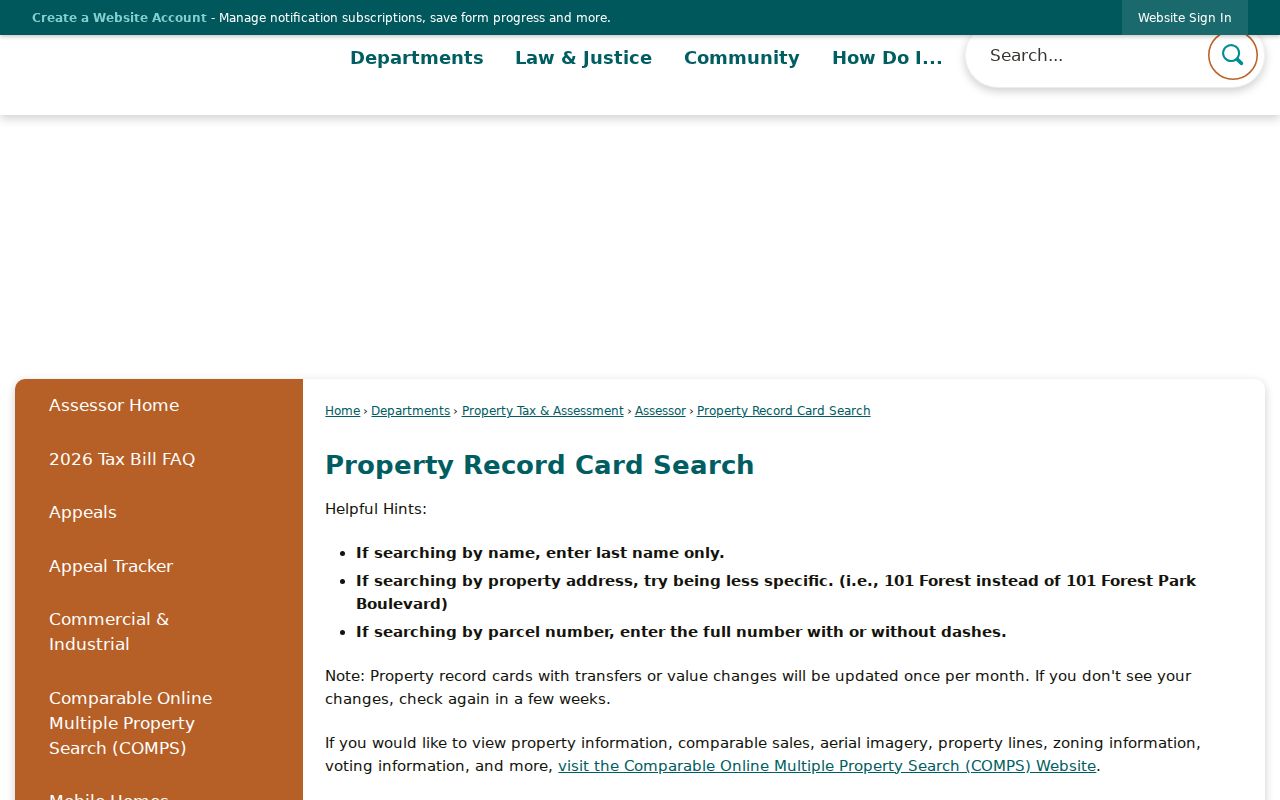
The update notice matters when fresh changes lag.
Save an Allen County Value Snapshot
Keep a dated snapshot. Note the parcel number, assessment year, land value, improvement value, total certified value, transfer date, reported price, and date viewed so later annual trending stays readable. Different years stop blurring together.