
Follow Allen County's Route to the Property Owner
Ownership in Allen County rests on two official snapshots. The Assessor card carries the current tax-roll name. The Recorder index shows the grantee on the latest deed. The parcel key and legal description bridge the two. Keeping the focus there answers the owner question directly instead of turning into a tour of every county portal.
- Enter the known address in PATI and open the matching parcel card.
- Record Property Owner Information, the parcel number, situs, mailing address, and transfer clue.
- Search that owner as a grantee in the Recorder's index and identify the newest deed for the same tract.
- Compare legal descriptions and any prior or parent parcel number before accepting the match.
- If an entity holds title, verify its exact legal name in Indiana's business records.
Recent closings can make the two disagree. Check both source dates. The Recorder posts new documents within 24 hours, while assessor cards refresh monthly, so a properly matched deed can be newer than the roll.
Read Allen County's Property Owner Field
The county's annotated card labels the key field Property Owner Information. It may hold one or more people. It may hold an LLC, trust, corporation, or estate. The nearby Property Address marks the situs. Owner and mailing fields instead show where tax correspondence goes, which can be a post office box, an agent, a trustee, or an address outside Allen County.
- Owner of record
- The party name carried on the assessment roll.
- Grantee
- The party receiving the stated interest in a deed.
- Vesting
- The deed language describing who takes the interest and in what capacity.
- Situs and mailing address
- The property location and the separate correspondence destination.
Each field answers a different question. A mailing address does not establish occupancy, and the assessor name is no substitute for reading how the deed vests title.
View the Allen County Owner Record Source
The Assessor Property Record Card Search supports lookups by last name, street address, or full parcel number.
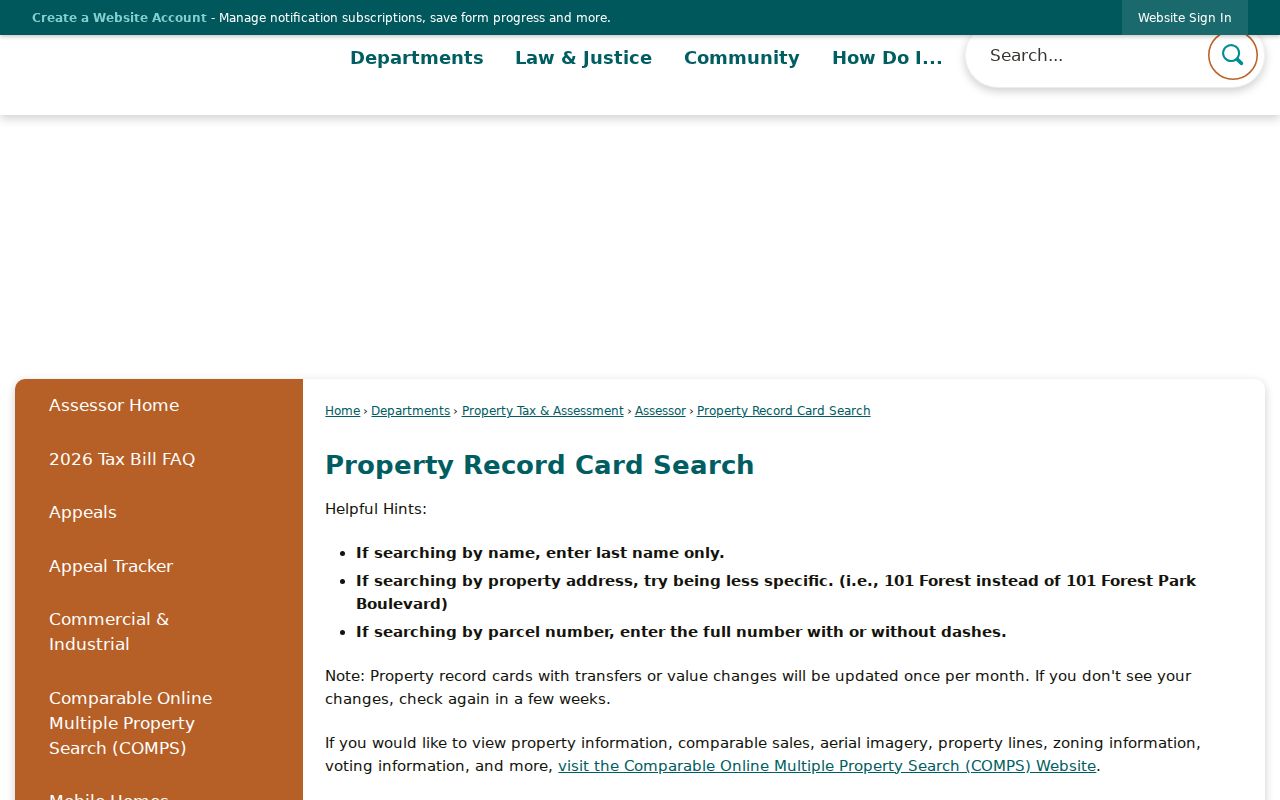
Pull the roll name from that source first. Then confirm it against the latest deed rather than treating a first result as a final conclusion about title.
Compare Allen County Property Ownership Sources
Each Allen County source offers its own mix of evidence and freshness. Stretch none beyond its purpose.
| Where ownership appears | What it contributes | Freshness and access |
|---|---|---|
| Assessor card and PATI | Roll owner, mailing and situs addresses, parcel key | Free public lookup; affected cards update monthly |
| Recorder deed index | Latest grantee, grantor, instrument, and recorded land description | New instruments usually post within 24 hours; free data has no images |
| iMap ownership layer | Owner clue attached to a mapped parcel | Free reference viewer; verify against Assessor and Recorder |
| INBiz | Entity name, status, and registered-agent filing details | Public entity search; agent is not automatically the landowner |
The records name the owner or recorded grantee, not necessarily a resident. A buyer may hold land through an entity. Correspondence may go elsewhere. A trustee may take title in a stated capacity, and the current-owner guide focuses on the present roll card and its timing.
Confirm Who Owns With the Allen County Deed
Open the Recorder Free Data Search with the assessor's exact owner string. Try the name with and without a middle initial. Try formal entity punctuation too. Locate the latest deed naming that party as grantee, then compare its legal description with the card or plat. A matching date and surname are not enough. The free search returns data without images. Tapestry sells paid one-time searching with images, Laredo offers recurring access, and the Recorder counter handles older documents and official copies. General online coverage begins January 1, 1970, Tapestry name searching reaches back to 1950, and address or parcel-number searching may fail before 1995.
Note: A just-recorded Allen County deed can identify the buyer before the monthly assessment-card refresh displays the new roll owner.
Resolve an Allen County LLC, Trust, or Estate Owner
An entity name is itself an owner clue. It appears in the record exactly as recorded. Check an LLC or corporation's spelling with the INBiz Business Search. Note the entity type, status, and filing history. Never treat the registered agent as the parcel owner. The deed's grantee clause controls the recorded party identity. For a trust, search the trust name and trustee in the stated capacity. For an estate, try the decedent, an "Estate of" form, the executor, administrator, or personal representative. Probate or an executor deed may explain a transfer, while a life estate or joint interest requires the complete instrument rather than a shortened card label.
Use the Allen County Parcel to Avoid a False Match
The permanent parcel number is the safest administrative key across PATI, the Assessor, and iMap. Allen County's format can include county, area, section, parcel-block, parcel, parent, split, and taxing-district components. Portal punctuation varies. Try the full digits with and without dashes. Splits and merges can hide a child parcel. In that case compare the deed's legal description, the plat, and any parent or split code before trusting the number. Name searching alone can blend parcels sharing a surname.
Ask Allen County Offices When the Web Route Fails
The web route sometimes dead-ends. Call the office instead. The Assessor sits at 1 East Main Street, Suite 415, Fort Wayne. It is reachable at 260-449-7123 on weekdays from 8 a.m. to 5 p.m. The Recorder is in Room 100 at the same address. Its number is 260-449-7165, with the same published hours. Bring the address, parcel number, spelling variants, and a date range. For a record missing from the direct portal, file a focused request. Submit it through Allen County NextRequest. Indiana's Access to Public Records Act applies, with exceptions. It never requires an office to build a new ownership report. Older deeds may need books, microfilm, or archive aids.
Know the Limits of an Allen County Owner Lookup
An Allen County owner lookup answers a narrow question. It names the owner of record on the parcel roll. Or it names the grantee in a recorded deed. It cannot tell you who lives at the address. No method here settles a boundary. It does not prove that every interest was recorded, and it does not certify marketable title. Treat mailing data as a tool for telling one parcel from another. Use it for sending legitimate property correspondence, and nothing more.
Indiana runs an Address Confidentiality Program that gives qualifying victims a substitute mailing address. State law also lets certain officials keep a home address off qualifying public property database websites. A custodian can redact that protected data and still release the public parcel information. A missing private field is not proof the record itself is missing.
Lawful use. Use Allen County property owner data for legitimate land research, purchase diligence, estate work, or civic questions. Public access never authorizes stalking, threats, impersonation, or harassment.
Sometimes the stakes go higher. When ownership must support a closing, a lawsuit, or another legal action, get the recorded instrument and qualified title or legal review. The public method finds and routes Allen County property records well, but it is not an opinion on title.