
Read the Instruments in Allen County Deed Records
Tracing land ownership in Allen County means following one deed to the next. Allen County deed records capture every transfer of an interest in land, from family sales to bank foreclosures. Each recorded document links the present owner to the ones before. A good property search starts with the current owner of record. It works backward through each grantor, using names, recording references, and legal descriptions rather than the street address alone. You can search Allen County property records by address, parcel number, or party name. Then pull each deed that ties the chain together. Older instruments sometimes need a different route.
| Deed Type | What It Does | Common Use |
|---|---|---|
| Warranty deed | Conveys the stated interest with deed warranties | Ordinary purchase transfers |
| Quitclaim deed | Conveys whatever interest the grantor holds | Family transfers and interest cleanup |
| Trustee or executor deed | Conveys through a fiduciary capacity | Trust and estate administration |
| Tax deed | Records a transfer arising from a tax-sale process | Researching tax-title ownership |
| Plat or covenant | Records subdivision layout or restrictions | Connecting a lot to its recorded neighborhood documents |
The type of document does not settle the question of good title. Vesting language, execution details, the legal description, and every later instrument all have to be read together. Some interests never reach the Recorder at all. Court judgments, state tax liens, and bankruptcies may live in court and federal files, so a full title examination reaches beyond the deed records the county holds.
Choose an Allen County Recorder Search Channel
Allen County gives searchers three electronic ways into its deed index, all reached through the Recorder search page. Free Data Search returns index facts but no images. Tapestry charges per search, while Laredo works on a subscription and behaves much like the terminal at the office.
| Access route | Best use | Published terms |
|---|---|---|
| Free Data Search | Find candidate party and instrument data | Data only, no images |
| Tapestry EON | Occasional searching and image review | $8.75 per search and $1 per printed page |
| Laredo | Repeated office-style work | Monthly packages; 75 cents per printed page |
| Recorder counter | Older books, help, and official copies | Confirm the certified-copy total with staff |
The counter sits at 1 East Main Street, Room 100, Fort Wayne, open weekdays from 8 a.m. to 5 p.m. Staff can be reached at 260-449-7165 or recorder@allencounty.in.gov. A quick call ahead helps when the volume you need or the copy method is unclear.
Search Allen County Deed Records With the Right Fields
The free index asks for a person or business name. It must match the recorded document exactly. The Recorder suggests running the name with and without a middle initial. Both forms can produce hits. Tapestry and Laredo widen the options with images and added search fields. Be aware that address and PIN searches carry a coverage limit on older material.
| Index field | Form | Allen County search note |
|---|---|---|
| Party or person name | Text | Search exact recorded order plus middle-initial variants. |
| Business name | Text | Try LLC punctuation, abbreviations, and formal entity variants. |
| Address or PIN | Optional, portal dependent | May not return records before 1995. |
| Document type | Portal category | Use deed, mortgage, release, easement, lien, plat, or covenant as applicable. |
| Date, instrument, or book/page | Narrowing reference | Preserve the exact reference displayed for later retrieval. |
Log every candidate carefully. Save the grantor, grantee, deed type, recording date, book-and-page or instrument reference, legal description, and parcel number when the record shows one. Consideration figures matter only if the actual deed displays them.
See the Allen County Deed Index Entry Point
The Recorder Free Data Search is the no-image starting point for a name-based review.
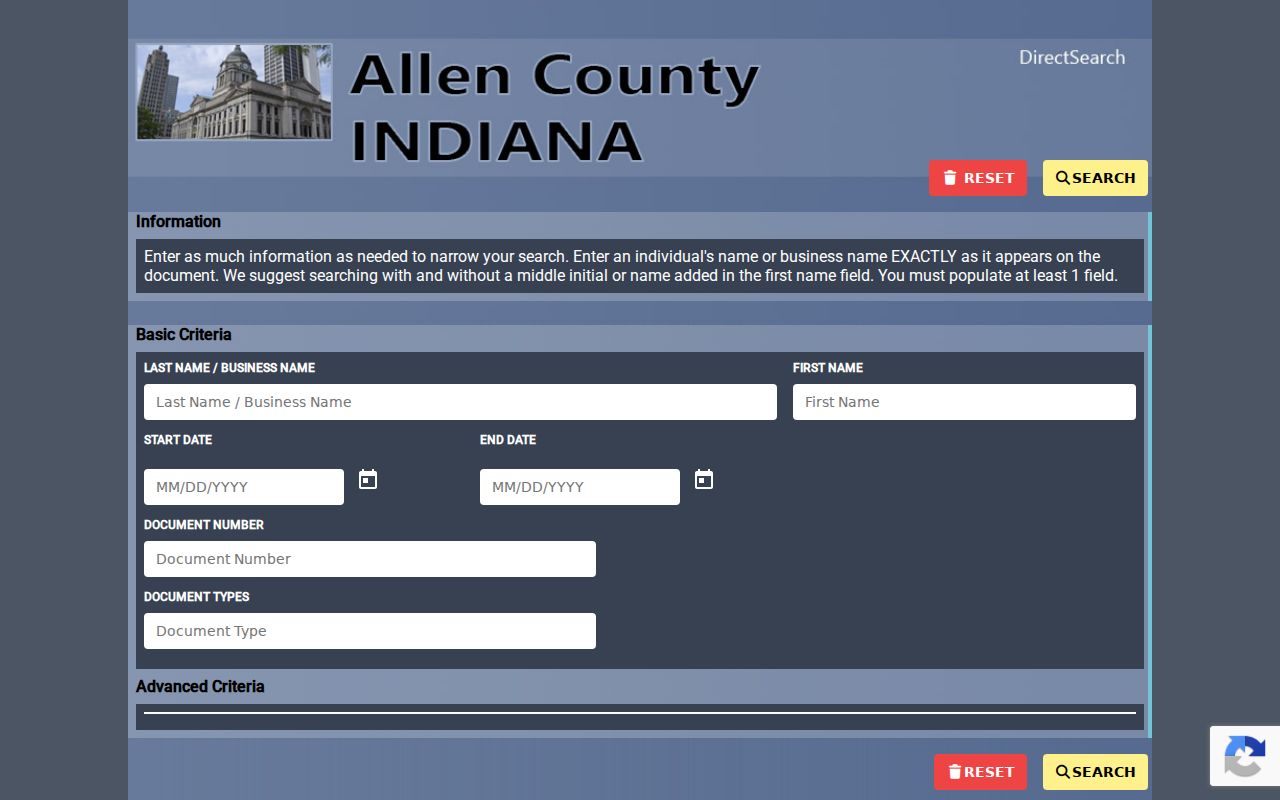
Treat the free interface as a way to gather candidate references. When an image or official copy is needed, move on to Tapestry, Laredo, or the Recorder counter in Allen County.
Walk Allen County's Grantor-Grantee Index Backward
Every chain starts with the present owner. Take the name from the current assessor card. Then search that party as a grantee to find the deed that transferred the tract. The grantor on that deed is the prior owner. So search that person as an earlier grantee next. Repeat the pattern deed by deed. Each step must move backward in time. The legal description must keep pointing to the same land in the Allen County property records.
- Copy the current roll name and permanent parcel number from the assessor card.
- Find the current party as grantee and record the latest deed's grantor and legal description.
- Search that grantor as grantee in the preceding period and verify the same tract.
- Repeat while noting splits, merges, estate deeds, trust names, and former parcel numbers.
- Move to paper indexes, deed books, or microfilm when online coverage ends.
- Grantor
- The party conveying the stated interest.
- Grantee
- The party receiving the stated interest.
- Chain of title
- The linked sequence of recorded conveyances for one tract.
- Book/page and instrument number
- Two systems used to cite where a recorded document can be retrieved.
A name chain is not the same as a parcel chain. Names change, replats rewrite legal descriptions, and a single deed can cover several tracts, so return to the legal description at every step of the Allen County property search.
Know Allen County's Online Cutoff Years
Online coverage has edges worth knowing. The Recorder publishes general data and documents from January 1, 1970 forward, along with certain earlier material. Tapestry name searches reach back to 1950. Address and PIN queries can fail before 1995, which means an old deed can exist even when a modern address search returns nothing. Deeper history takes legwork. The Indiana State Library holds an Allen County microfilm finding aid, and preservation material points to Deed Book A from 1832 and Book B from 1852. Clerk holdings begin near county formation in 1824. Remember that Clerk custody and Recorder custody are not interchangeable.
Online is not complete. The 1950 name reach and 1970 general image coverage do not replace older indexes, microfilm, and deed books.
Use Allen County Plats and Covenants With Deeds
A deed often names a lot, section, or restriction instead of a modern neighborhood, and the Recorder's Neighborhood Resource Center bridges that gap. It links addresses to subdivision and section names. It also runs a free keyword search across more than 7,500 covenant and subdivision documents, making it a practical companion to the deed records when a plat reference needs context.
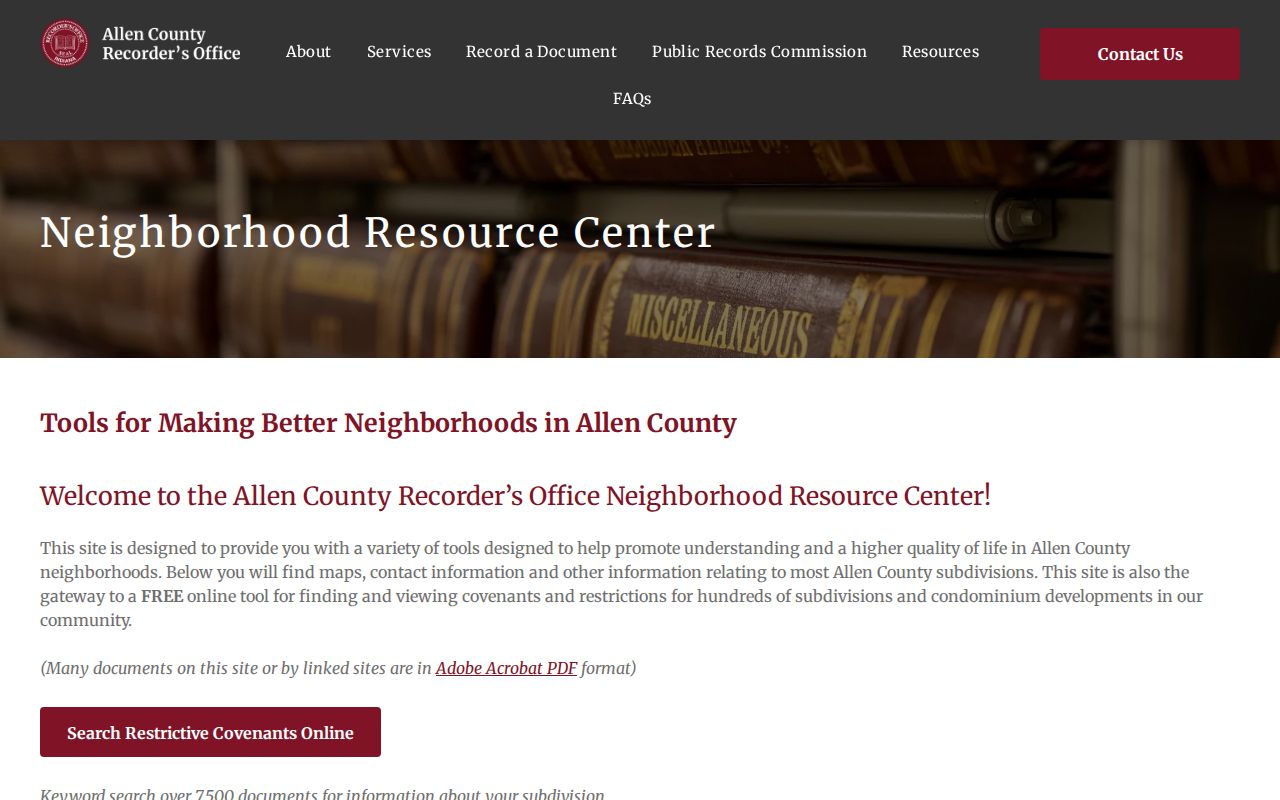
Less search text often returns better results, the Recorder advises. Large files can take several minutes to open, so patience pays. Begin with the core subdivision or association name, then confirm the recorded instrument itself rather than treating a neighborhood label as the legal description of the parcel.
Follow Allen County Deeds Beyond the Recorder
The Recorder warns that court judgments, state tax liens, and bankruptcies are not always in its deed index. The Indiana MyCase portal shows public Allen Circuit and Superior Court activity. The Clerk can be asked about records outside the automated system. Federal bankruptcy work may require PACER and the Northern District of Indiana. Other files fill gaps. Probate records can explain an executor deed. A recorded release clears a mortgage that still shows in an earlier instrument. Deed records identify the conveyance chain. A formal title search weighs the full set of interests and defects.
Protect a Name in Allen County Deed Records
The Recorder offers a free Property Fraud Alert that watches a registered name and sends notice when it appears in a new recording. It has limits. The service does not track parcel boundaries or judge whether a document is fraudulent, so verify any alert through an independent Recorder search or the office phone before acting.
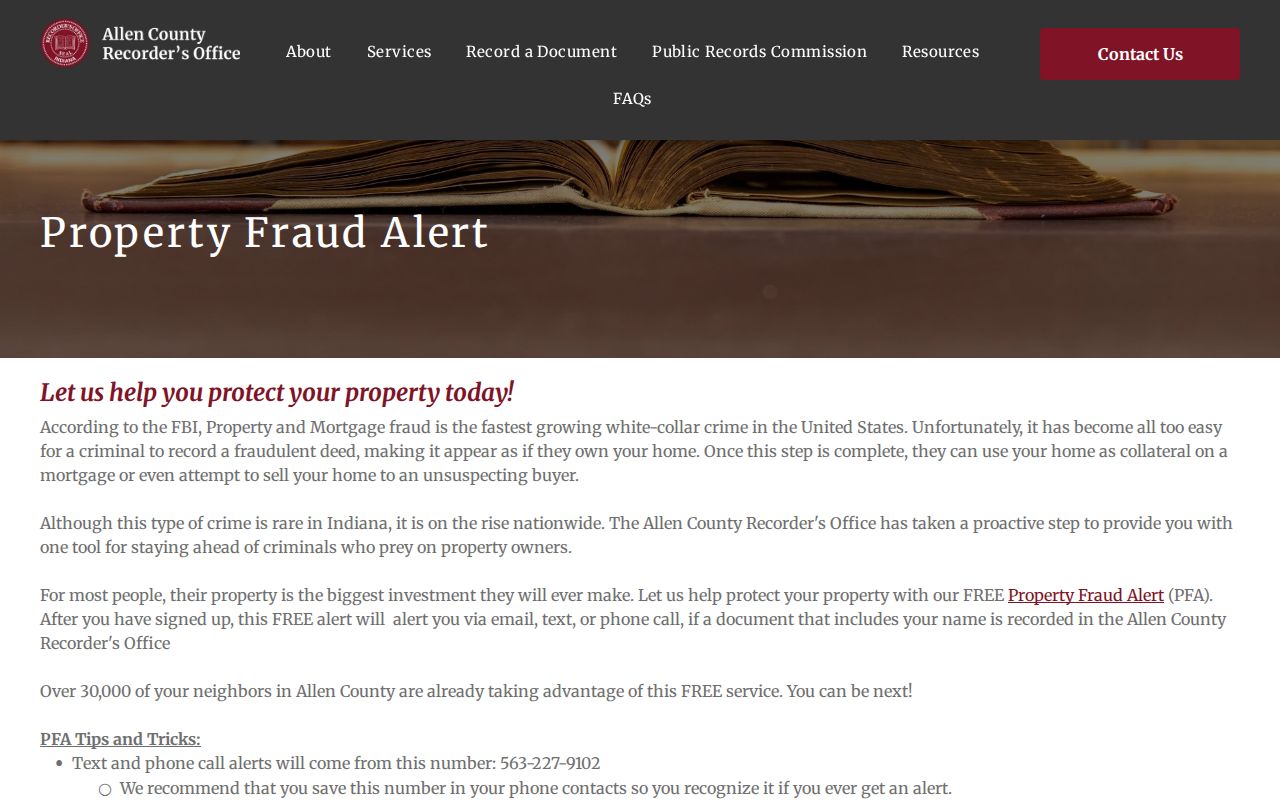
The Recorder holds more than 3.1 million online documents, and alert signups total 62,373. That scale rewards care. A common misspelling can hide a deed in Allen County records, so register every name variant the service supports before relying on alerts.
When a hit appears, pull the instrument number first. Read the deed itself before drawing any conclusion about ownership or liens.
Obtain an Allen County Deed Copy
An online image often settles a preliminary question. For anything official, though, the Allen County Recorder supplies copies and certifications. Tapestry suits one-time users and charges per printed page. Laredo serves recurring users with heavier search needs. Older deeds may never appear online at all. Bring the party names, an approximate date, an instrument or book/page reference, and the legal description when you visit or call.
The Recorder's page lists no clear certified-copy total. Confirm the amount and the accepted request method with staff before sending payment. If a deed is missing from the web index, say so. Explain that the request concerns an existing deed or index entry. Give the narrowest date range possible. General county records requests can go through NextRequest. A deed-copy question, however, should start with the Recorder as its direct custodian.
Recorded, not guaranteed. Allen County deed records show instruments accepted for recording. They are not a title opinion, and an unrecorded interest or record held elsewhere can still matter.