
Fields Inside Allen County Property Tax Records
Three Allen County offices split the tax trail. The Assessor sets market value-in-use and certifies land and improvement values for each parcel. The Auditor handles conveyances, deductions, and billing data. The Treasurer bills, collects, and tracks delinquency and tax-sale payments. Each role answers a different question. Reading them in order keeps an assessed value from being mistaken for a payment balance, and a deduction from being read as a change in ownership.
| Field | What It Shows | Where |
|---|---|---|
| Land value | Certified assessed value assigned to the land for a given year | Assessor property card |
| Improvement value | Certified value of buildings and other assessed improvements | Assessor property card |
| Total and net assessed value | Value before and after eligible deductions affect the tax base | Assessor and Auditor data |
| Bill and payment status | Installments, charges, adjustments, payments, and balance when loaded | Treasurer through PATI |
| Taxing district | The local units whose approved rates contribute to the bill | Auditor and tax bill |
Allen County property cards can carry more than values. Finished square feet, construction details, prior transfers, and neighborhood factors used in mass appraisal often appear there too. Those facts help explain a value. Still, a tax bill is not a sale-price estimate, and for the difference between the numbers see the Allen County property value guide.
Why Allen County Splits the Tax Trail Three Ways
Three Allen County offices do not duplicate one another. The Assessor values real property using cost, income, and sales-comparison approaches. The Auditor assigns taxing information, applies credits and deductions, and supports conveyance and tax-sale work. The Treasurer then collects the tax and verifies payments. Errors point to different doors. A wrong name or transfer goes to the Assessor or Auditor, a disputed value goes to the appeal process, and a missing payment goes to the Treasurer.
Assessment record
Allen County Assessor, Rousseau Centre Suite 415, 260-449-7123, weekdays 8 a.m. to 5 p.m.
Tax account
Allen County Treasurer, Rousseau Centre Suite 104, 260-449-7693, weekdays 8 a.m. to 5 p.m.
Search Allen County Tax Records in PATI
Most Allen County tax research runs through Public Access Tax Information, or PATI. It covers property cards, Form 11 notices, tax amounts, deductions, bill reprints, and payment research. Copy the parcel or duplicate number first. That official card is the best key. A broad name search can return many parcels. A street suffix or punctuation difference can hide an address hit.
| Search field | Format that works best | Use |
|---|---|---|
| Name | Smith, John | Find parcels connected to a taxpayer name |
| Address | Street number plus street name | Find the situs parcel |
| Parcel number | Full number, with or without dashes | Match the exact tax parcel |
| Duplicate number | Digits only | Open the billing account directly |
PATI needs JavaScript to show tax details. A blank screen is not proof that a parcel has no tax record. Use the Assessor card search, call the office, or go in person.
Land, Improvements, and Allen County Taxable Amounts
An Allen County property card breaks value into pieces. Land, improvements, and total assessed value appear by year. Work in progress, residential components, effective year built, finished area, bath count, and neighborhood and location factors can show up too. Indiana targets 100 percent of market value-in-use statewide. Mass appraisal applies that standard, not an individual sale appraisal.
Gross assessed value is the certified total before deductions. Net assessed value comes after deductions and feeds the eventual bill. A homestead deduction shifts the taxable base. It does not touch the deed, the parcel boundary, or the price a buyer may pay. Stick to one assessment year when comparing, since figures from two cycles can sit side by side on screen.
Allen County Annual Trending and the Four-Year Cycle
Trending and reassessment work together in Indiana. The Department of Local Government Finance schedules a four-year cycle beginning July 1, 2026, reassessing about one quarter of property each year for 2026-pay-2027 taxes. Allen County's 2026 tax FAQ offers local numbers. It says 2024 closed sales trended the 2025-pay-2026 assessments. The median sale price rose 5.6 percent, and overall net assessed value climbed 4.34 percent.
Countywide figures show a cycle's direction. They say nothing about whether one parcel is correct. A sound review weighs characteristics, neighborhood assignment, condition, and relevant sales. Cards with transfer or value changes update monthly. Save the year and date on every screen you compare, because figures from different points in time can mislead.
Look Up an Allen County Property Tax Bill
A reliable lookup takes two steps. First, match the address to a single parcel. Then move to the billing account. That order keeps you from grabbing a similarly named owner or a neighboring lot. Bills go out around April 10 with spring and fall coupons, due May 11 and November 10, 2026, and taxes are paid in arrears in two installments.
- Search the Assessor card by a shortened address, then copy the full parcel and duplicate numbers.
- Open PATI and use that exact key to view or print the tax bill and check the recorded payments.
- Compare the bill to the card and confirm which deductions appear in the Auditor data.
- If installments remain delinquent, check the county tax-sale page and contact the Treasurer before acting.
- Assessed value
- The tax-oriented value assigned under Indiana assessment rules.
- Levy or tax rate
- The approved charge applied through the parcel's taxing district.
- Homestead deduction
- Eligible relief applied by the Auditor to a qualifying principal residence.
- Tax lien
- A claim associated with unpaid tax; its status needs confirmation in official records.
Delinquent Allen County Property Tax and Sale Lists
Allen County posts current and prior tax-sale material on its Tax Sale page. County guidance sets the threshold. Three or more missed installments trigger eligibility. A list entry is a warning, not a verdict. It does not prove a sale finished or that ownership changed, so confirm the parcel number, owner name, sale stage, redemption terms, and any later payment with the Treasurer or Auditor.
Federal liens can change what a tax-sale purchase actually delivers. Other claims may sit outside the Recorder. Search the official sources before trusting a list. The Treasurer also warns that its office never calls or texts delinquent taxpayers. Treat any unsolicited demand as a scam clue and call the published county number yourself.
See the Allen County Tax Access Page
For current due dates, payment links, and office contacts, the official Treasurer page is the place to start.
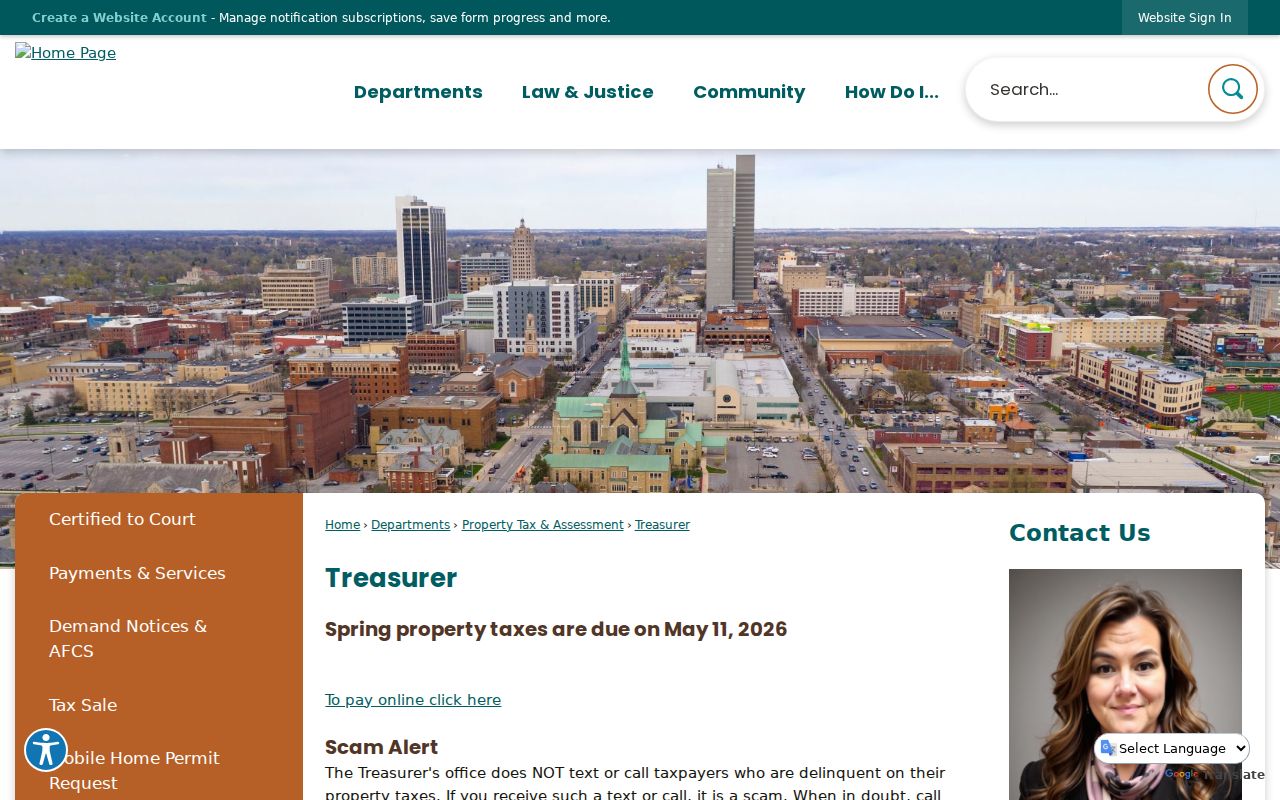
Check the page again close to a due date. The Treasurer updates links and deadlines there as terms change.
When the Allen County Tax Portal Is Not Enough
A website is not the only route to Allen County property tax records. The Assessor, Auditor, and Treasurer counters sit inside the Rousseau Centre during weekday office hours. Each takes phone questions too. Staff there can reconcile a record that looks wrong online. When something is not posted at all, Allen County's NextRequest portal opens an APRA path. Any request should name a record that already exists. Include the parcel, the year, and the office that holds it. Indiana's Access to Public Records Act does not oblige staff to build a new analysis on request. If the use is formal, ask for a certified or office-issued copy. A browser printout works fine for casual research. It may miss later adjustments, though. It also carries no certification a formal proceeding would demand. Inspection is generally free. Lawful charges for copies, formats, vendors, mailing, or certification can apply.
Contest an Allen County Property Tax Assessment
An appeal targets valuation alone. It does not contest the Treasurer's arithmetic or a recorded deed. The Allen County appeals page points owners to Form 130 and the Property Tax Assessment Board of Appeals. That board hears the case. Good evidence helps. Comparable sales, photographs, an appraisal, or factual fixes to the property record card all count. Explain plainly why the assessed value fails to reflect market value-in-use.
Protect the deadline. File Form 130 by June 15 of the assessment year or within 45 days of the notice, whichever is later.
File the form through the channels the county lists. The appeal fact sheet walks through the later stages, including Form 134 and Form 131. If no determination arrives within 180 days, state guidance describes an escalation option. Keep proof of filing. Keep paying taxes as directed while the appeal is pending. Filing alone does not erase a bill.